Vibe coding got you 80% of the way there, the other 20% matters the most
TL;DR: Vibe coding is brilliant at producing something that looks and feels like a real product, fast. What it doesn't reliably produce is the unglamorous 20% that drives everything: proper authentication, error handling, data validation, monitoring, and backups. That 20% is also often the difference between a product people can trust and one they abandon.
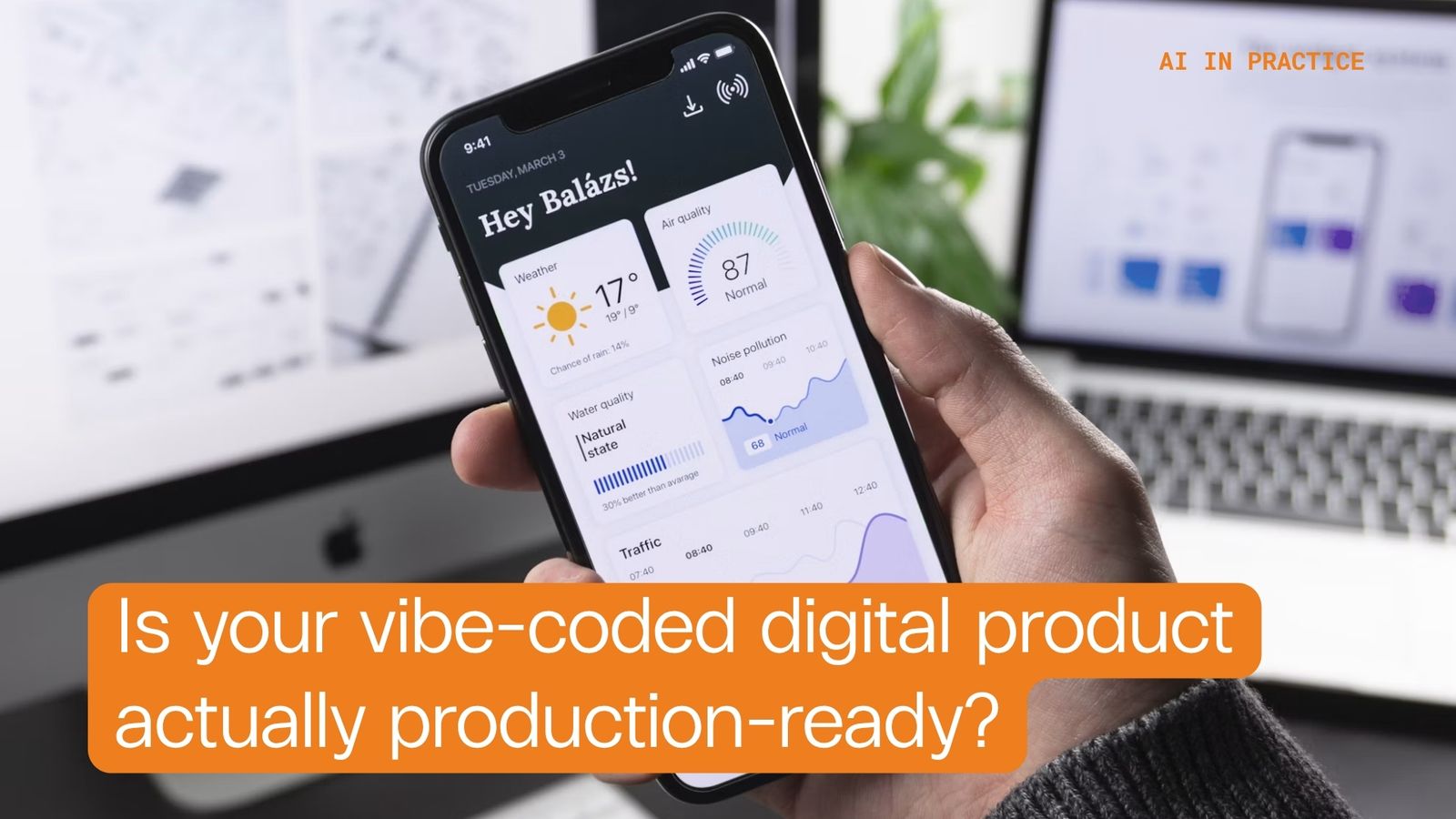
In the last year especially, many people have shown me a product built almost entirely through prompts, and it looks fantastic. The UI is clean, the core flow works, and it usually took a weekend instead of a quarter. Ten, or even five years ago, that same product would have needed a small team and several months. It’s undeniably impressive.
But then I ask a few questions. What happens if a user's session token expires mid-payment? What does someone see if the API times out? What happens to the data if a bad input slips through? Usually, there's a pause. That pause is the last 20% of an app build that all too often marks the difference between success and failure.
Why does the last 20% get skipped?
The last 20% often gets skipped because it's invisible in a demo. Nobody stress-tests a product while showing it to a friend or an investor. The foundational functionality and custom feature sets only show up under conditions nobody thought to simulate: a bad connection, a duplicate submission, a user typing something unexpected into a field, or a spike in traffic at 2am.
AI coding tools are optimised to get you to "it works" as fast as possible, because that's the prompt you gave them. Not many people prompt "and also, harden this against edge cases I haven't thought of yet”. Nor does AI know exactly how to action this kind of prompt without more specific direction. So it doesn't happen, not because the tools are bad, but because the necessary instructions and deeper understanding wasn’t brought into the mix.
Let's get specific: what's actually missing in your vibe-coded app?
These are the gaps I’ve seen most consistently in vibe-coded products.
1. Authentication that only handles the ‘happy path’.
The ideal flow of a user, including all generic login and signup steps, usually works. However, actions like password resets, session expiry, and what happens when a token goes stale mid-action, often doesn’t work. This is the layer that can easily lose users or where an attacker will target first.
2. Error handling that assumes nothing will go wrong.
A product built quickly tends to plan for success and skip failure. When an API call fails, a payment doesn't clear, or a third-party service goes down, the user is often left staring at a blank screen or a raw error message, with no idea what happened or what to do next.
3. Data validation that trusts the user completely.
If a form accepts whatever is typed into it without checking, that's a data integrity problem waiting to surface later, usually as corrupted records, broken reports, or a support ticket nobody can explain.
4. Monitoring that doesn't exist until something breaks.
Without monitoring, the first person to know something is wrong is a customer, not you. By the time you find out, the damage to trust is already done and the user has likely gone elsewhere.
5. Backups that were never actually tested.
Having a backup and having a backup that restores cleanly are two different claims. Most founders discover the difference at the worst possible moment, which is exactly when they needed it to just work.
Bonus: Custom features and flourishes that speak directly to your users.
While it’s a whole different topic, it’s worth mentioning here that in addition to not closing potential gaps, AI-built digital products also often fall short of speaking directly to your target audience. The right custom builds add in ways that delight and retain attention, eventually turning visitors to paying customers.
There’s a pattern in the issues of vibe-coded apps and websites. None are about whether the AI-generated code is good, it's about how the code functions overall, and the scaffolding that only becomes visible when something goes wrong.
How do I check if my product has this gap? A self checklist
Ask yourself these questions honestly, and you'll get a clearer picture of how much of the last, and arguably most important, part of your build is still outstanding.
- If your primary API or payment provider went down for ten minutes right now, what would your users see? If you're not sure, that's a potentially damaging gap.
- Can someone submit malformed or malicious data through your forms and have it accepted? If you haven't tried, assume yes until proven otherwise.
- Would you find out about an outage from your own systems, or from an angry customer message? The answer tells you whether monitoring exists in practice or only in theory.
- Have you actually restored from a backup, recently, on purpose? An untested backup is a hope, not a safeguard.
None of these are things a prompt answers well, because they're not really coding questions, they're more questions about what happens when the product meets real users instead of a demo audience.
Does this mean vibe coding was the wrong approach?
No. Vibe coding is exactly the right tool for getting from nothing to something fast, and that speed can be an advantage in many cases. The mistake isn't using AI to build quickly, but it’s important to understand that it can only take you so far.
The founders who get this right don't throw out the AI-built foundation, but they do treat the last 20% as its own deliberate phase, with its own checklist, rather than assuming it'll sort itself out once the product finds traction.
When is it time to bring in outside help?
Before you find out the hard way. The gaps in the last phase of your product build are rarely obvious to the person who built the product, because more often than not you've been testing the happy path the whole time. An outside set of eyes, ideally ones that have seen this exact pattern many times before, tends to spot the gap in an afternoon that would otherwise surface as a 2am incident.
Add to that the right kind of growth partner, and you have a collaborator who not only understands how to get your digital product up to scratch, but how to ensure its performance, optimisation and marketability over time.
Our approach at Voyage
We work with innovators and founders whose AI-built products are up and running, but they’re just not working as they should.
We get that last 20% done properly: authentication that holds up, error handling that protects the user experience, validation that keeps data clean, monitoring that tells you first, and backups you can actually trust because we've tested them.
We're here to make sure the invisible parts hold, so the visible parts keep earning trust. Wherever relevant, we also help you reach and retain the right kind of audience, so your product becomes a business that earns revenue and grows over time.
If your product looks finished but you're not fully sure what happens when something goes wrong, get in touch.